
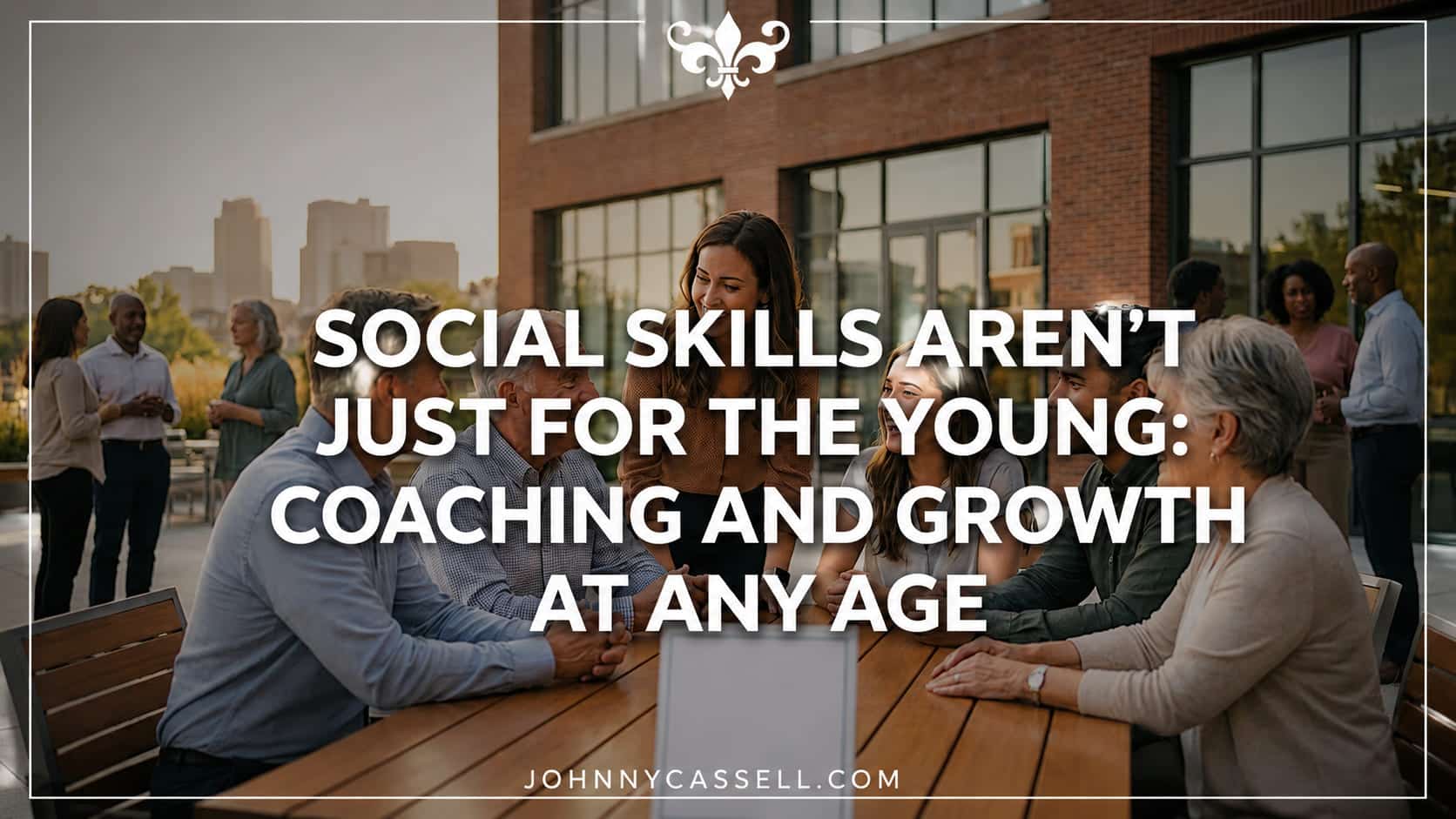
SOCIAL SKILLS COACHING AND GROWTH AT ANY AGE
Social Confidence & Relationships | JohnnyCassell.com
There's a belief that quietly calcifies in high-performing men somewhere around midlife.
The belief that the person they are socially is the person they'll always be.
That the habits are fixed.
The patterns are permanent.
And the best they can do is manage their limitations rather than evolve beyond them.
It's one of the most expensive beliefs a man can hold.
And it's completely wrong.
“You spent thirty years mastering your profession. You really think twelve months can't transform your social life?”
Why Midlife Is Actually Ideal For Growth
Most people believe social skill development belongs to the young.
The reality is often the opposite.
Midlife creates advantages younger people simply don't have.
You have context.
Young people learn social skills through trial and error without understanding why certain things work.
By midlife, you possess decades of social experience.
Relationships that succeeded.
Conversations that failed.
Patterns you've observed repeatedly in people and environments.
New skills land faster when integrated into existing awareness.
Your stakes are real.
The quality of your relationships now genuinely affects your health, happiness, confidence, and future.
That level of emotional relevance accelerates learning dramatically.
Your identity is more stable.
In your twenties, you're still becoming yourself.
By midlife, you know who you are.
That self-awareness makes growth cleaner, faster, and more authentic because you are refining identity rather than searching for it.
You have more resources.
Better environments.
Better coaching.
Better opportunities.
The ability to intentionally place yourself in rooms and experiences that accelerate growth.
Young men often lack access.
You don't.
The Myth That You're 'Set' Socially
One of the biggest misconceptions around ageing is the belief that personality and social ability become fixed permanently after a certain age.
The science doesn't support that.
Adult brains remain highly adaptable, especially in areas connected to emotional regulation, communication, social awareness, and relational behaviour.
What creates change isn't youth.
It's repetition.
Challenge.
Exposure.
Consistency.
The men who transform socially in their forties, fifties, and sixties are not anomalies.
They're simply men who stayed open to growth while others quietly accepted stagnation.
The brain is far more adaptable than most people allow themselves to believe.
WHAT SOCIAL GROWTH ACTUALLY LOOKS LIKE
Real social development in midlife doesn't mean becoming someone else.
It means becoming more fully yourself.
What changes:
The ease of starting conversations.
The ability to read social dynamics accurately.
The confidence to stop performing and become genuinely present.
The capacity for emotional depth without defensiveness.
The consistency required to turn interactions into lasting relationships.
What doesn't change:
Your values.
Your character.
Your identity.
The goal isn't reinvention.
The goal is removing the defensive habits, fears, and social conditioning that stop people experiencing the best version of who you already are.
The Coaching Conversation Most Men Avoid
Many high-performing men invest heavily in business growth.
Executive coaching.
Leadership development.
Mentorship.
Performance optimisation.
Yet almost none invest in social and relational development with the same seriousness.
And that's despite relationships having more influence on long-term wellbeing than almost anything else in life.
The research is remarkably consistent.
The quality of your relationships strongly predicts happiness, emotional resilience, physical health, and longevity.
Not status.
Not money.
Not career success.
Relationships.
Yet most men continue investing in every area of life except the one the data repeatedly shows matters most.
“The quality of your relationships quietly shapes the quality of your entire life.”
Where Real Change Begins
Growth starts with honest assessment.
Not:
“Am I a good person?”
You probably are.
Not:
“Do people generally like me?”
They probably do.
The better questions are:
Am I building the level of connection I genuinely want?
Am I showing up socially as the most authentic version of myself?
Am I creating a social world that will nourish the next decade of my life?
If the answer to any of those is no — or even uncertainty — that's the starting point.
Because the second half of your life can absolutely become socially richer, emotionally deeper, and relationally stronger than the first.
But only if you treat growth in this area with the same seriousness you've already applied elsewhere.
Fix you first. Then watch how every relationship around you changes.
PRIVATE STRATEGY
Ready To Grow Socially At Any Age?
Johnny’s private coaching programmes help ambitious men develop authentic confidence, stronger communication skills, and deeper social connection in every stage of life.