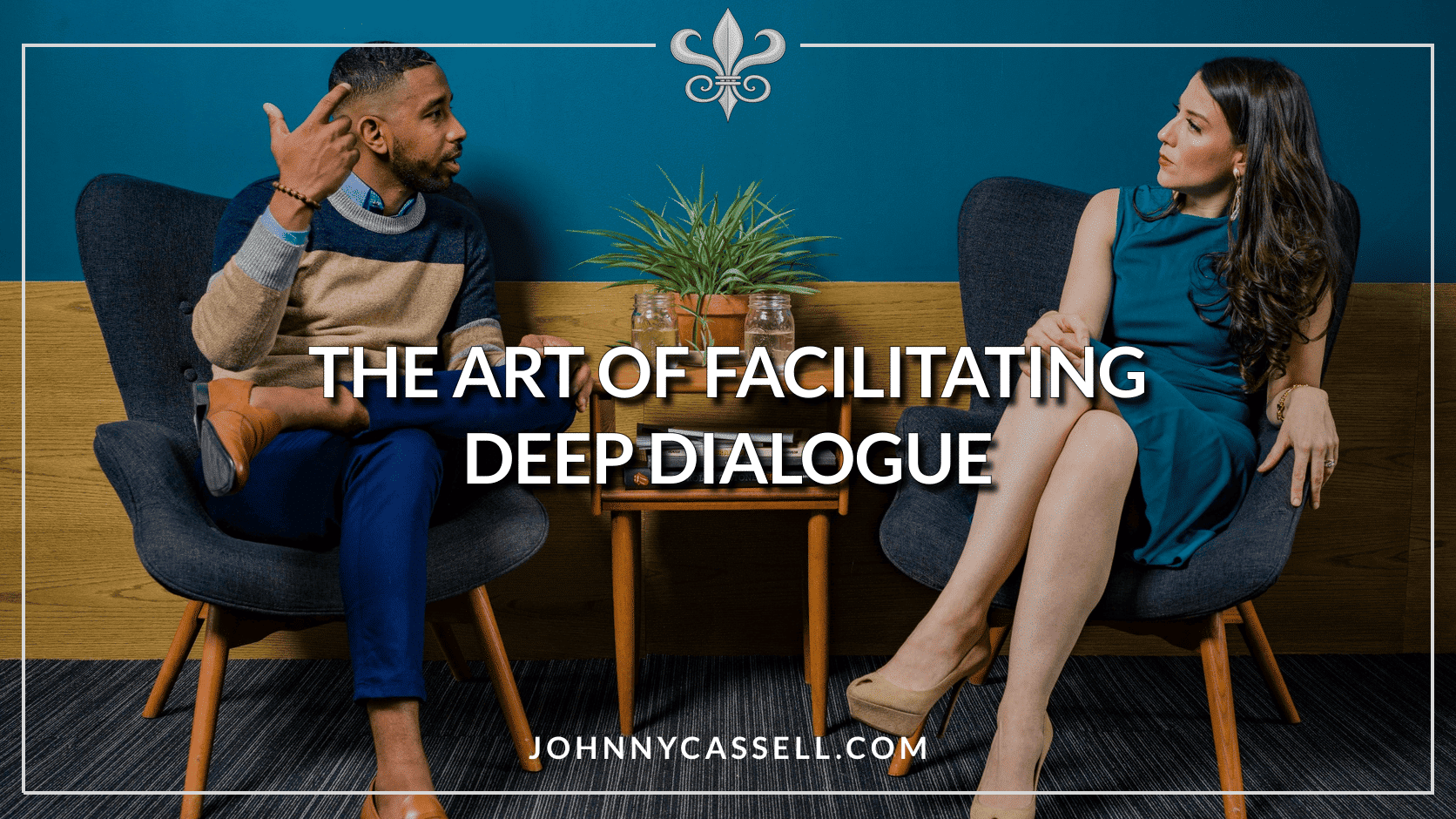
The Art of Facilitating Deep Dialogue
Good conversation is not about how to stop running out of things to say with women
Nor is it about firing questions at someone in the hope that one of them creates a connection.
The most engaging conversations tend to happen when both people feel sufficiently comfortable to move beyond surface-level exchanges and speak with greater honesty, curiosity and depth.
That is the art of facilitating deep dialogue.
It is not interrogation. It is not performance. And it is certainly not about memorising a list of “good questions”.
It is about creating the conditions in which a more meaningful conversation can naturally emerge.
Curiosity Is More Important Than Technique
People can usually tell when somebody is genuinely interested in them.
They can also tell when a question is being asked simply because somebody has been taught that it is the right thing to say.
Authentic curiosity feels different.
When you are genuinely interested in another person, you are not merely waiting for your turn to speak. You listen to what they are saying, notice what matters to them and explore the parts of the conversation that seem to contain energy.
This often means asking fewer questions, not more.
A single thoughtful follow-up can create a richer conversation than ten unrelated questions.
If somebody mentions that they recently changed career, for example, the interesting part may not be what their new job involves. It may be why they decided to change direction.
That is where the person begins to emerge behind the facts.
Move Beyond Information
Most early conversations revolve around information.
Where do you live?
What do you do?
Where have you travelled?
What are you doing this weekend?
There is nothing wrong with these questions. They help establish context.
But information alone rarely creates intimacy.
Deeper conversations explore meaning.
Instead of simply learning what somebody does, you begin to understand what they enjoy about it. Instead of cataloguing the places they have visited, you discover which experiences actually changed them.
The difference is subtle but important.
One conversation gathers facts.
The other reveals character.
Listen for the Doorways
Interesting conversations constantly contain small doorways into deeper subjects.
Most people walk straight past them.
Someone might casually mention that they moved countries, ended a long relationship, started a business, changed careers or developed an unexpected passion.
Each of those comments contains a story.
A socially perceptive person notices these openings.
Rather than immediately redirecting the conversation back towards themselves, they allow the other person to expand.
You might simply say, “What prompted that?”
Or, “Was that something you had wanted to do for a long time?”
The precise wording matters far less than the intention behind it.
You are signalling: I heard what you said, and I am interested enough to understand it properly.
Share, Don’t Interview
One of the easiest ways to make a conversation feel unnatural is to ask question after question without revealing anything about yourself.
Connection requires exchange.
When somebody shares something interesting or personal, respond to it. Offer your own perspective. Tell a related story. Allow them to learn something about you as well.
The best conversations develop rhythm.
One person speaks. The other listens. Something in that answer creates a new thought, memory or question. The conversation moves naturally rather than following a predetermined path.
This balance is especially important in dating.
You are not there to conduct an interview.
You are discovering whether two people actually enjoy each other’s minds, humour, perspectives and company.
Become Comfortable With Pauses
People who lack conversational confidence often feel compelled to fill every silence.
They interpret a pause as evidence that something has gone wrong.
Usually, it hasn’t.
A short silence can give somebody time to think. It can add emphasis to something that has just been said. It can create a moment of eye contact or simply allow the interaction to breathe.
Confident communicators do not panic when conversation slows.
They remain relaxed.
That calmness prevents an interaction from feeling rushed and often encourages more thoughtful responses.
Depth requires a little space.
Ask Questions You Actually Care About
There is no universally perfect question.
A sophisticated conversation should reflect your genuine interests and personality.
If you are interested in ambition, ask people what they are building or working towards.
If you care about travel, explore the experiences that changed their perspective.
If you value relationships and family, allow those subjects to emerge when appropriate.
The objective is not to engineer a particular emotional response.
It is to discover the person in front of you.
This also makes you more discerning.
Great conversation is not simply about making somebody like you. It helps you understand whether you actually like them.
Depth Must Be Earned
Not every conversation needs to become profound.
Trying to force emotional intimacy too quickly can feel artificial or intrusive.
People reveal more when they feel comfortable, respected and understood.
That trust develops gradually.
A light conversation may become playful. Playfulness may become curiosity. Curiosity may lead naturally into more personal subjects.
Allow that progression.
Social intelligence includes knowing when to go deeper and when to keep things easy.
The Conversation Beneath the Conversation
Ultimately, deep dialogue is less about the questions you ask and more about the quality of attention you bring.
Are you listening?
Are you curious?
Are you willing to reveal something of yourself?
Can you resist the urge to impress?
Can you allow somebody to finish their thought without immediately redirecting the conversation?
These qualities create something increasingly rare: the experience of being genuinely heard.
And that is where memorable conversation begins.
Not with a scripted question.
With active listening, curiosity and the confidence to let a real conversation unfold.
Want to develop more natural, engaging and meaningful conversations? Johnny’s coaching programmes help you improve your social intelligence, confidence and ability to create genuine connection in real-world situations.
No obligation. Honest guidance only.